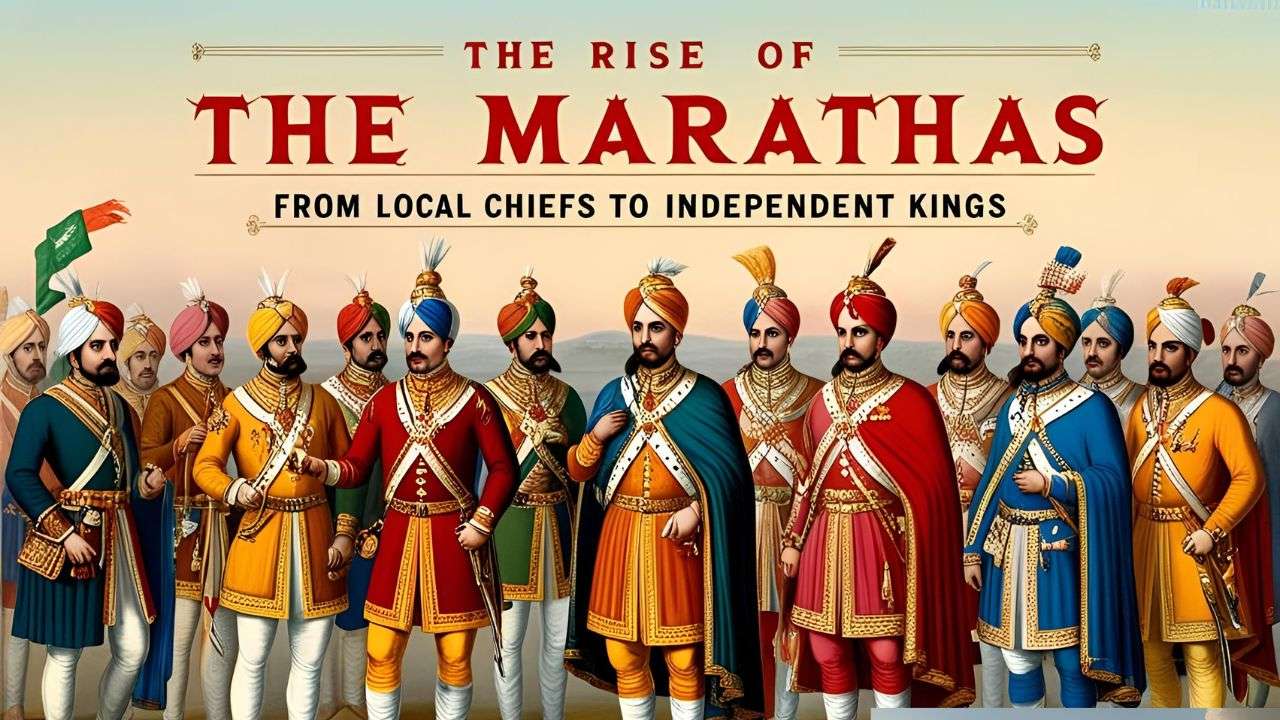
The Rise of the Marathas: From Local Chiefs to Independent Kings
The rise of the Marathas in medieval India, beginning around the 8th century, is a compelling narrative of transformation from local chieftains to architects of an independent state. Comparable to the Rajputs, the Marathas emerged through a complex process of social and political evolution, marked by Brahmanization and Kshatriasation. These processes elevated groups engaged in military service and granted land, forming a distinct social class with specific codes of conduct, such as forgoing widow remarriage and certain foods to assert higher status.
Unlike the Rajputs, who established independent states earlier, the Marathas initially operated as powerful local chiefs, commanding loosely organized auxiliaries known as bargirs, and were valued as allies rather than autonomous rulers. The 17th century, particularly under Shivaji Bhonsle, saw the Marathas transcend their role as regional players to establish a formidable independent state, challenging both Mughal and regional powers. This article explores the historical context, key figures, and pivotal events that shaped the Maratha ascent, culminating in their emergence as a dominant force in the Deccan.
Table of Contents
The Rise of the Marathas
The Marathas’ rise was deeply intertwined with the socio-political dynamics of medieval India. Military service and land grants were critical in shaping a distinct Maratha identity. Those who served in armies and received land formed a cohesive group, marrying within their ranks and adhering to a code that distinguished them from other communities. This process of Kshatriasation, coupled with Brahmanization, allowed Maratha families to claim higher social status, aligning themselves with the warrior ethos of the Kshatriya varna.
From the era of the Bahmani kingdom (1347–1527) and its successor states, Maratha chiefs, or sardars, were integral to regional governance. Families like the Mores, Ghatges, and Nimalkars wielded local authority, serving as military and administrative leaders. Their influence grew as powers like Malik Ambar of Ahmadnagar and later the Mughals competed for their loyalty. This competition elevated the Marathas’ strategic importance, positioning them as key players in the Deccan’s power struggles. However, unlike the Rajputs, who carved out independent kingdoms like Mewar and Marwar, the Marathas initially lacked well-established sovereign states, functioning instead as powerful local allies with significant followings.
The Bhonsle Family: Foundations of Maratha Power
The establishment of an independent Maratha state is inextricably linked to the Bhonsle family, particularly Shivaji. The family’s ascent began with Babaji, Shivaji’s ancestor, who served as the patel (headman) of Hingani Beradi and Devalgaon in the Poona district. His sons, Maloji and Vithoji, started as petty horsemen under the Jadhavs of Sindkhed in the Daulatabad district, while another branch, the Ghorpades, held prominence in Bijapur. Maloji’s service under Malik Ambar, a key figure in the Ahmadnagar Sultanate, marked a turning point. In 1622, Malik Ambar granted Shahji, Maloji’s son, the parganas of Sholapur and Poona, previously held by Murari Pandit for Bijapur. Shahji’s successful ousting of Murari Jagdev demonstrated his military prowess and secured his control over these territories.
Shahji’s career was marked by shifting allegiances, reflective of the fluid political landscape. In 1630, following the treacherous murder of his father-in-law, Lukhaji Jadhav, at the Ahmadnagar court, Shahji defected to the Mughals. Shah Jahan awarded him a mansab of 5,000 zat and 5,000 sawar, along with Poona as his jagir. His brother Minaji and elder son Sambhaji also received mansabs. However, Shahji’s Mughal alliance was short-lived. In 1632, when Fath Khan, Malik Ambar’s son, surrendered Daulatabad to the Mughals, Shahji returned to Bijapur’s service, emerging as a champion of the Nizam Shahi dynasty. He installed a Nizam Shahi prince at Shahgarh, backed by Bijapur’s force of 7,000–8,000 horsemen and supported by disbanded Nizam Shahi nobles and soldiers. His forces swelled to 20,000, allowing him to control territories yielding 20.75 lakh huns out of Ahmadnagar’s total yield of 84 lakh huns, rivaling the holdings of Bijapur (20.25 lakh huns) and the Mughals (21 lakh huns).
The 1636 treaty between Bijapur and the Mughals forced Shahji to relinquish his Ahmadnagar territories and join Bijapur’s service in Karnataka, far from the Mughal frontier. There, he sought to establish a semi-independent principality at Bangalore, mirroring the ambitions of figures like Mir Jumla of Golconda and the Sidis on the western coast. Shahji left his Poona jagir to his senior wife, Jija Bai, and their young son, Shivaji, setting the stage for the latter’s rise.
Shivaji’s Early Career: Laying the Groundwork
Shivaji’s ascent began in the 1640s, a period of political instability in the Deccan. At just 18, between 1645 and 1647, he captured key hill forts near Poona—Rajgarh, Kondana, and Torna—demonstrating his military acumen. The death of his guardian, Dadaji Kondadeo, in 1647 gave Shivaji full control of his father’s jagir. His actions aligned with Shahji’s ambitions in Bangalore, exploiting the neglect of the Poona region by Bijapur, which had shifted its focus southward after the 1636 treaty, and the Mughals, preoccupied with Central Asian campaigns.
A 1644 farman to Kanhoji Jedhe indicated that Shahji faced disgrace due to rebellious activities by Dadaji Kondadeva at Kondana, leading to his imprisonment in 1649 after the death of his patron, Randaulah Khan. Shivaji’s intercession with the Mughals secured Shahji’s release, showcasing his growing influence. In 1656, Shahji visited Poona, likely advising Shivaji on administration before his death.
Shivaji’s major breakthrough came in 1656 with the conquest of Javli from Chandra Rao More, achieved through treachery. This victory secured the Mavala highlands, access to Satara, and the Konkan coast, with Mavali foot soldiers bolstering his army. Shivaji further strengthened his position by capturing additional hill forts near Poona, laying the foundation for a robust Maratha power base.
Shivaji’s Conflicts with Bijapur and the Mughals
The Mughal invasion of Bijapur in 1657 provided Shivaji a strategic opening. He negotiated with Aurangzeb, securing confirmation of his forts and mahals in Bijapur territory, including the port of Dabhol. However, Aurangzeb rejected his demand for additional Adil Shahi Konkan territories. Exploiting the Mughal civil war, Shivaji seized Purandar and north Konkan, including Kalyan and Bhiwandi, critical for Bijapur’s trade, particularly the import of war horses.
Bijapur responded in 1659 by sending Afzal Khan with 10,000 troops to capture Shivaji. Aware of Afzal Khan’s treacherous reputation, Shivaji outwitted him at the Battle of Pratapgarh, killing him during a staged meeting and routing his army. This victory enabled Shivaji to capture Panhala and expand into south Konkan and Kolhapur, earning him legendary status. His exploits attracted Maratha and Afghan mercenaries, enhancing his military strength.
Aurangzeb, alarmed by Shivaji’s rise, tasked Shaista Khan with invading his territories in 1660. Shaista Khan occupied Poona and secured north Konkan, but Shivaji retaliated with a daring night attack on the Khan’s camp in 1663, wounding him and killing his son. This humiliated Shaista Khan, who was transferred to Bengal. In 1664, Shivaji raided Surat, the Mughals’ premier port, amassing treasure worth a crore of rupees, further solidifying his reputation.
The Treaty of Purandar and the Agra Visit
Aurangzeb’s response to Shivaji’s growing power was to appoint Mirza Raja Jai Singh in 1665 to subdue him. Jai Singh, granted full military and administrative authority, isolated Shivaji by rallying his rivals and besieging Purandar, where Shivaji had lodged his family and treasures. Facing defeat, Shivaji negotiated the Treaty of Purandar, surrendering 23 of his 35 forts (yielding four lakh huns annually) while retaining 12 forts (one lakh huns). He was granted Bijapuri Konkan territory worth four lakh huns and promised Balaghat territory worth five lakh huns if he could conquer it, in exchange for paying 40 lakh huns to the Mughals. Sambhaji received a mansab of 5,000, exempting Shivaji from personal service, though he agreed to join Mughal campaigns in the Deccan.
Jai Singh envisioned a Mughal-Maratha alliance to conquer Bijapur, but Aurangzeb’s reservations undermined this plan. The emperor reluctantly approved the campaign but provided inadequate resources. Bijapur’s scorched-earth tactics and Golconda’s support (12,000 sawars and 40,000 foot) further hampered Jai Singh’s efforts. When the campaign faltered, Diler Khan and others blamed Shivaji, demanding his imprisonment. Jai Singh sent Shivaji to besiege Panhala, but he failed. To salvage his strategy, Jai Singh persuaded Shivaji to visit Aurangzeb at Agra in 1666.
The Agra visit was a disaster. Shivaji, expecting a mansab of at least 7,000, was insulted by being treated as a mansabdar of 5,000, a rank already granted to his son. Feeling humiliated, he stormed out, refusing imperial service. Aurangzeb’s court, including Jahanara and Jaswant Singh, demanded punishment to uphold imperial dignity. Jai Singh advocated leniency, but before a decision was made, Shivaji escaped in 1666, a turning point in Mughal-Maratha relations. Aurangzeb later regretted his carelessness, but his failure to value Shivaji’s alliance, viewing him as a mere bhumia, was a significant political misstep.
Administration under Shivaji
Shivaji’s administration was heavily influenced by the Deccani states, particularly the practices of Malik Ambar, but he adapted these to create a centralized, disciplined system. Contrary to modern interpretations, Shivaji did not have a council of eight ministers but rather eight secretaries, known as the ashtapradhans, each directly accountable to him. These secretaries lacked discretionary power, ensuring that Shivaji retained absolute control, a hallmark of what some historians describe as a dictatorial form of governance.
The ashtapradhans included:
- Peshwa (Chief Minister): Oversaw general administration and finance, later evolving into a revenue and finance minister.
- Amatya or Majumdar (Accountant General): Managed financial accounts and audits.
- Sachiv or Surunavis (Chitnis): Handled royal correspondence.
- Sumant or Dabir: Managed foreign affairs and served as master of ceremonies.
- Senapati or Sar-i-Naubat: Commanded the military, overseeing recruitment, training, and discipline.
- Mantri or Waqia Navis: Managed intelligence, household affairs, and the king’s personal safety.
- Nyayadhish: Administered justice.
- Pandit Rao: Oversaw charitable and religious affairs, focusing on moral upliftment.
Each ashtapradhan was supported by a staff of eight clerks, including a diwan (secretary), mujumdar (auditor), fadnis (deputy auditor), sabnis (office in-charge), karkhanis (commissary), chitnis (correspondence clerk), jamdar (treasurer), and potnis (cashier). Three ministers—Peshwa, Sachiv, and Mantri—were also tasked with governing extensive provinces, while all except the Nyayadhish and Pandit Rao were required to serve in wartime.
Shivaji’s territorial administration was hierarchical, dividing his kingdom into three provinces, each under a viceroy, further subdivided into prants, parganas, and tarafs, with villages led by a patel (headman). He strictly regulated mirasdars, hereditary landholders who had become unruly, destroying their strongholds and forcing their submission. This centralization aimed to curb local power and ensure loyalty to the state.
Revenue System: Exploitation and Innovation
Shivaji’s revenue system, patterned on Malik Ambar’s kathi system, was both innovative and controversial. Land was measured using a rod (kathi), ensuring precise assessments. He abolished the jagirdari system, replacing it with the ryotwari system, where cultivators paid directly to the state, reducing the power of intermediaries like deshmukhs, deshpandes, patils, and kulkarnis. However, John Fryer’s account paints a grim picture, describing the system as tyrannical, with three-fourths of the agricultural yield extracted as revenue, particularly from Maratha-speaking Canarese and Kundi agriculturists. This heavy taxation was seen as exploitative, with revenue officials, often Brahmins, facing imprisonment if they failed to meet targets.
Two distinctive taxes, chauth and sardeshmukhi, were central to Shivaji’s revenue system. Chauth, a quarter of the assessed revenue, originated from zamindari rights and was levied on non-Maratha territories as a form of protection money, ensuring Shivaji’s forces would not plunder those areas. Sardeshmukhi, an additional 10% levy, was tied to customary land claims. Critics, including later historian Azad Bilgrami, viewed chauth as a form of blackmail, reflecting the Marathas’ zamindar-like outlook rather than imperial ambitions. Unlike the subsidiary alliances of the British under Lord Wellesley, where protection was guaranteed, chauth only ensured the Marathas themselves would not raid the paying territories.
Shivaji also awarded mokasa (jagirs) and saranjam (revenue grants) to his officials and military chiefs, continuing the deshmukhi system in some areas. In 1679, Annaji Datto completed a new revenue assessment, refining the system to maximize state income while maintaining control over hereditary revenue officials.
Military Organization: Discipline and Mobility
Shivaji’s military was a cornerstone of his power, characterized by strict discipline and rapid mobility. His army comprised a regular cavalry (paga) of 30,000–40,000, supplemented by silahdars (auxiliaries) under havaldars who received fixed salaries. Infantry, primarily Mavali foot soldiers, and a strong navy completed his forces. Forts were governed by three officers of equal rank to prevent treachery, a testament to Shivaji’s strategic foresight.
The army’s structure included:
- Sar-i-Naubat (Senapati): Army commander, responsible for recruitment and discipline.
- Qiladars: Fort officers.
- Nayak: Led infantry units.
- Havaldar: Oversaw five Nayaks.
- Jumladar: Commanded five Nayaks.
- Ghuraw: Boats with guns.
- Gallivat: Rowing boats with 40–50 rowers.
- Paik: Foot soldiers.
Shivaji’s maxim, as per Fryer, was “No plunder, no pay!” Soldiers were often unpaid, expected to sustain themselves through plunder, leading Fryer to describe them as “half-naked rascals.” However, regular soldiers received cash salaries, while chiefs could be granted saranjam. Strict discipline prohibited women or dancing girls from accompanying the army, ensuring focus during campaigns. The army operated year-round, except during the rainy season, with pindaries (irregular troops) allowed to collect 25% of war booty (pal-patti).
Shivaji’s navy was a notable innovation, enabling control over coastal regions like the Konkan. His forces’ rapid mobility made them effective in guerrilla warfare, allowing them to outmaneuver larger armies like those of the Mughals and Bijapur.
Shivaji’s Titles and Ideology
Upon assuming royal powers, Shivaji adopted the title Haindava Dharmodharak (Protector of the Hindu Faith), signaling his intent to position himself as a defender of Hindu interests. However, Fryer notes that this did not prevent him from plundering Hindu populations, suggesting a pragmatic approach over ideological purity. His administration blended Mughal and Bijapuri titles, with terms like subadar (equivalent to Mughal thanedar) and faujdar (equivalent to Mughal chaukidar) used for officials with limited jurisdictions, reflecting a mix of grandeur and localized authority.
Conflicts and Achievements
Shivaji’s rise was marked by bold military campaigns and strategic alliances. His early conquests, such as the capture of hill forts like Rajgarh, Kondana, and Torna (1645–47), and the treacherous conquest of Javli in 1656, secured the Mavala highlands and Konkan coast. His 1659 victory over Bijapur’s Afzal Khan at Pratapgarh, achieved through cunning, cemented his reputation, leading to the capture of Panhala and expansion into south Konkan and Kolhapur. His 1663 night attack on Mughal viceroy Shaista Khan’s camp and the 1664 raid on Surat, yielding treasure worth a crore of rupees, showcased his audacity and strategic brilliance.
The 1665 Treaty of Purandar with the Mughals, negotiated under pressure from Mirza Raja Jai Singh, saw Shivaji surrender 23 forts but retain key territories in exchange for loyalty to the Mughal throne. His 1666 visit to Agra, intended to secure Mughal support, ended in humiliation when he was treated as a mere mansabdar of 5,000, prompting his dramatic escape. This episode marked a turning point, hardening Shivaji’s resolve to pursue independence.
Critiques and Limitations
Despite his achievements, Shivaji’s administration faced criticism. Fryer’s account highlights the exploitative nature of his revenue system, with heavy taxation and harsh treatment of revenue officials and agriculturists. The chauth and sardeshmukhi taxes, while innovative, were seen as predatory, reinforcing the zamindar-like outlook critiqued by Azad Bilgrami in 1761. Bilgrami argued that the Marathas, despite battlefield successes, failed to establish a lasting imperial framework, with later leaders like the Peshwas and Nana Phadnis reducing the Raja of Satara to a puppet. This suggests an inherent limitation in the Maratha state’s political vision, which prioritized immediate gains over centralized authority.
Shivaji’s dictatorial governance, with no discretionary power for his ashtapradhans, ensured control but limited administrative flexibility. His reliance on plunder to sustain his army, as noted by Fryer, underscored logistical challenges, particularly in maintaining a regular pay structure. These critiques highlight the tensions between Shivaji’s innovative systems and the practical challenges of sustaining a nascent state amidst powerful rivals.
Legacy of Shivaji’s Maratha State
Shivaji’s administration and military organization laid the groundwork for a Maratha state that challenged Mughal hegemony and reshaped the Deccan’s political landscape. His centralized governance, disciplined army, and innovative revenue systems enabled rapid expansion and resilience against larger powers. The ryotwari system, chauth, and sardeshmukhi reflected a blend of local traditions and strategic pragmatism, while his navy and hill forts provided a tactical edge.
However, the Maratha state’s zamindar-like outlook, as critiqued by Bilgrami, limited its ability to evolve into a cohesive empire. The reliance on plunder and heavy taxation strained relations with local populations, and the lack of a strong political repository hindered long-term stability. Nevertheless, Shivaji’s legacy as a visionary leader endures. His ability to transform the Marathas from local chiefs into a sovereign power, through strategic brilliance and relentless ambition, remains a defining chapter in Indian history. The Maratha state under Shivaji was not just a military triumph but a testament to the power of localized resistance against imperial dominance, setting the stage for future Maratha expansion in the 18th century.
for further study click
relevant post: The Mughal Nobility Under Aurangzeb

One thought on “The Rise of the Marathas: From Local Chiefs to Independent Kings”